Most of us have the experience that a small room could be cooled down in several minutes, but for a larger space, the temperature decreases slowly even though the air conditioner has been operating for a long time. It doesn't mean the air conditioner has not enough cooling ability; instead, a most important physical concept contributed to the situation—thermal inertia, which is often being omitted.
I. What's thermal inertia?
Thermal inertia is the insensitivity level of an object or space to the temperature exchanges. Simply, it means the higher the thermal inertia, the slower the temperature exchanges; and the lower the thermal inertia, the faster the temperature exchanges.
It is not simple data, which is determined by three factors: mass, specific heat capacity, and the heat exchange conditions.
Inside the buildings and rooms, the thermal inertia performs mainly in walls, ceilings, floors, appliances, and the air itself. All those items will store heat.
II. Why does a larger house have a higher thermal inertia?
1. More items which store heat in the house
The larger house has wider wall areas, larger air volume, more concrete and bricks used in construction, and more space to put appliances and decorations. These are all heat storages. When the outside temperature is high, those heat storages have absorbed much heat already.
2. Air conditioning is to remove heat first, not to lower the temperature
The core task of air conditioners is not to blow cold air but to remove the heat from indoors to the outdoors steadily.
In large spaces, the air conditioner needs to remove heat from walls, floors, appliances, and the air steadily. The larger the space, the more heat needed to be removed, so it took a longer time.
3. The surface temperature determines the body temperature
Though the temperature had been cooled down, if the wall is hot, the floor is hot, and the appliance surface is hot, according to reflection heat transfer, the human body will feel its heat as well.
That's why people still don't feel cool even though the temperature already shows 24℃ in the large house. Thermal inertia makes it much slower for people to get "real coolness."
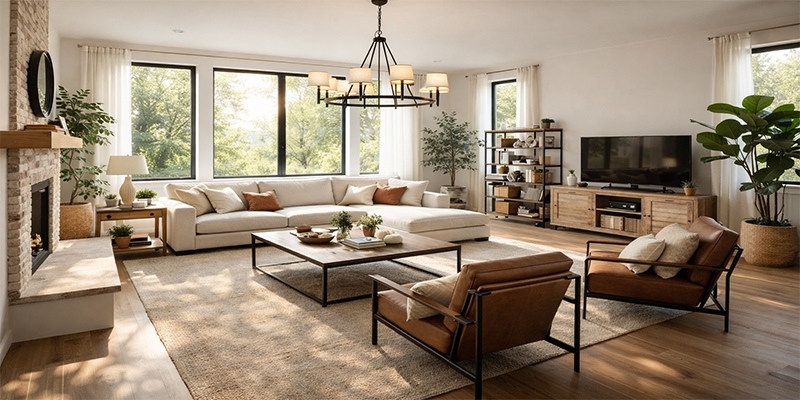
III. Why it may not necessarily solve the issue by purchasing a larger capacity cooling device?
Most people will choose a larger capacity air conditioner to cool a large house, such as a floor standing air conditioner or a cassette air conditioner. But the common questions are unreasonable gas-liquid distribution, cold air cannot reach the areas with heat burden, unreasonable air-return design, and long-term stays of heat in a partial area. As a result, the energy consumption rises, but the comfort has no significant improvement.
IV. For cooling in the large spaces, the key is to deal with the thermal inertia
1. Start the air conditioner in advance, rather than operating it when it's hot
2. Focus on the airflow coverage, rather than the cooling capacity
3. Zoning control, separately dealing with the thermal inertia
4. Matching the air conditioning systematically rather than focusing on the unit datas
In large houses, villas, and commercial spaces, VRF, ducted air conditioners, and joint-combined systems are more suitable in both comfort and energy savings.
In the large houses, it's not harder to blow cold air but to remove more heat, which is the thermal inertia that influences it. What determines the comfort is not only how big the air conditioner is, but also whether the whole system is recognized and allowed to operate by following the physical rules.